Man on the Moon
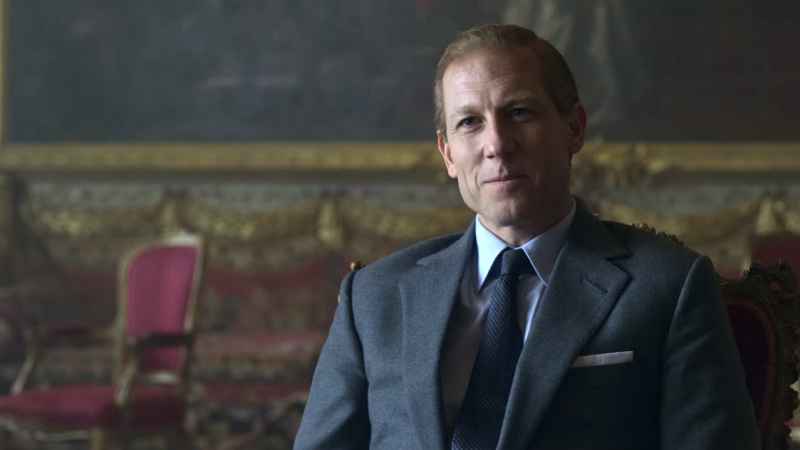
Seasons 1 and 2 of The Crown followed Philip’s journey toward settling into his role as husband and consort to Elizabeth. In Season 3, episode 7, we find him not only settled but feeling rather stagnant, a state of being which, as a “man of action,” he cannot accept.
As he says at the end of the episode, these feelings of emptiness have come on gradually, but they reach an apex with the landmark event of Apollo 11 landing on the moon. Writer Peter Morgan cleverly uses the moon landing as both a backdrop as well as a metaphor for Philip’s mid-life crisis. After meeting the astronauts as well as the new Dean of Windsor, Philip discovers he has been seeking wonder and fulfillment in all the wrong places.
Upon his “take-off,” Philip is even more irritable than usual, lashing out at anyone he perceives to be not using his/her time well, from Elizabeth at church to the new recruits at the Academy of Religious and Personal Growth recently established on the Windsor grounds. Elizabeth believes church is a time to reflect and “take stock,” while Philip says he’ll now be spending that hour “doing something useful.”
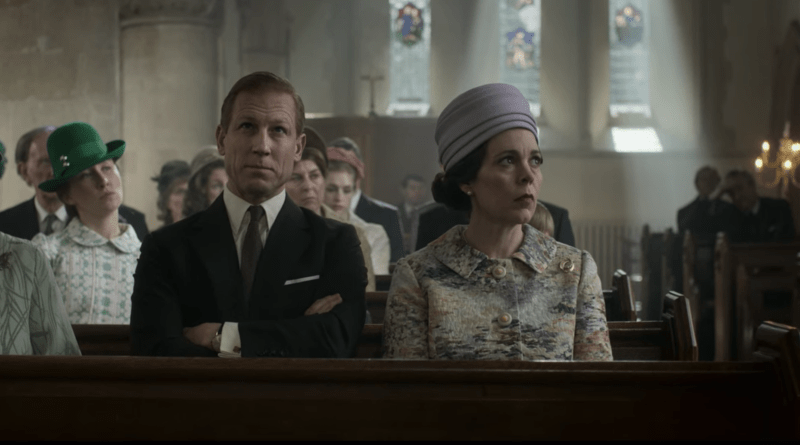
For the men taking off on Apollo 11, Philip says, “Extraordinary! What men. What courage.” To the new Dean of Windsor, Robin Woods, who wishes to use one of the vacant houses as a place for mid-career clergymen to come and “recharge” by “talking, thinking, reading,” Philip says his concept is flawed, that one can only “raise his game” through action.
His choicest words are for the clergymen who have come to this new academy. He joins them in a circle as they describe the lack of direction and redundancy they’re experiencing in their personal and professional lives. They speak of people seeking to meet their spiritual needs elsewhere. Philip proffers “the moon” as such a place, proving their point that people are turning from religion to science.
When Philip is asked for his thoughts, he loses all reservation and tells them they need to get off their backsides and do something- that “action defines us, not suffering.” Once again he invokes the achievements of the astronauts saying they’re too busy doing something “spectacular” to feel sorry for themselves, unlike this lot.
After calling them, “a bunch of navel-gazing underachievers infecting one another with gaseous doom” he tells them to clean up the floor from their muddy boots.
It’s Philip at his worst: harsh, judgmental and pretentious, and of course it all stems from his own insecurities as he wrestles with the reality of what he has/hasn’t achieved in his life.
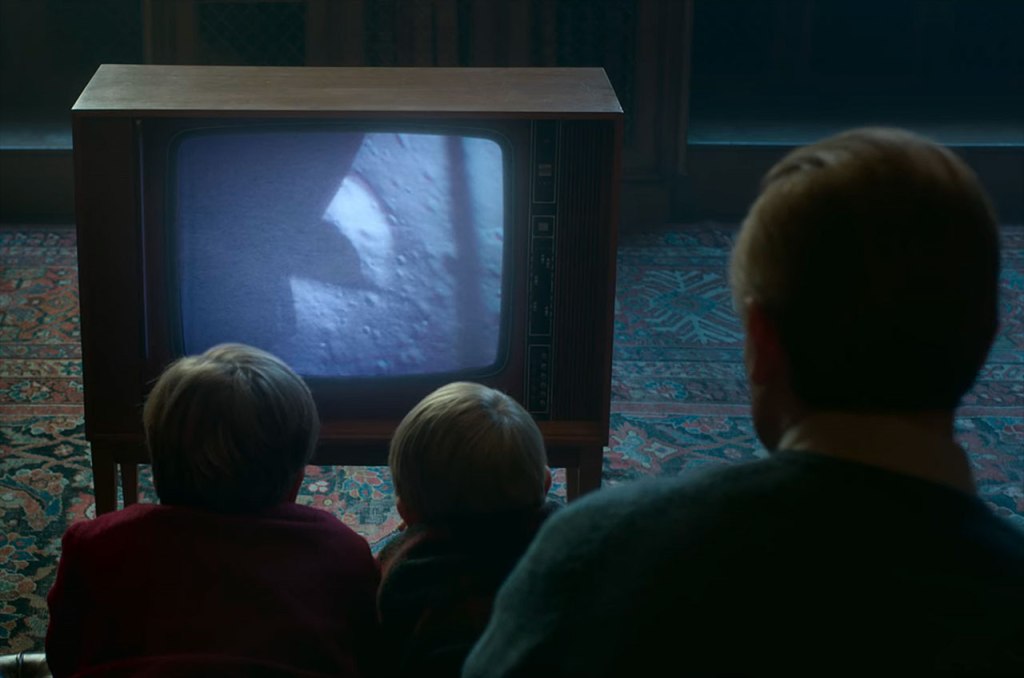
The actual landing on the moon has Philip filled with such anticipation it’s as though he is personally invested in the success or failure of the mission. When they do land and walk on the lunar surface, Philip is absolutely enthralled and so full of emotion that he sheds a tear. However, what he perceives as a defining moment in the “capacity for greatness within the human species,” turns out to be as anticlimactic as his meeting with the astronauts.
These men who have been on the moon and seen the earth from its surface gaze in awe and wonder at the walls of Buckingham Palace. Philip has a prepared list of questions, but it becomes apparent almost immediately to him and to the viewer how wrongly he has judged them. Still, he presses on, confessing to them his disappointment in not achieving what he would have liked to by now “as a man, as an adventurer…watching you was like watching a dream.”
The trouble is, these are men of science, men of protocol and procedure, not men of faith and philosophy like the clergymen Philip insulted earlier. They weren’t the “giants” Philip had created them to be in his mind; even the landing on the moon was not quite what he had made it out to be. Robin Woods more accurately captured the moon as nothing more than a “monochromatic void…an unknowable vastness.”
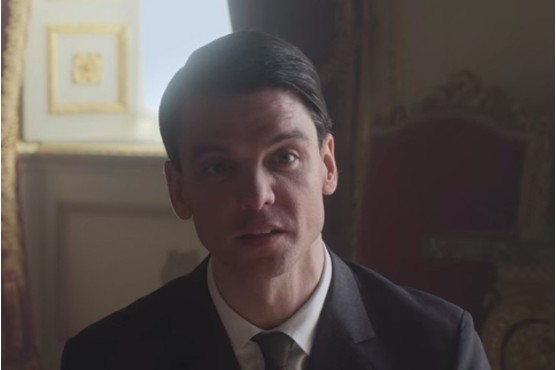
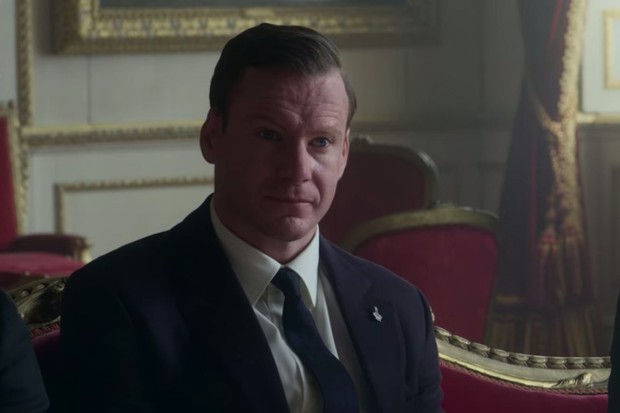
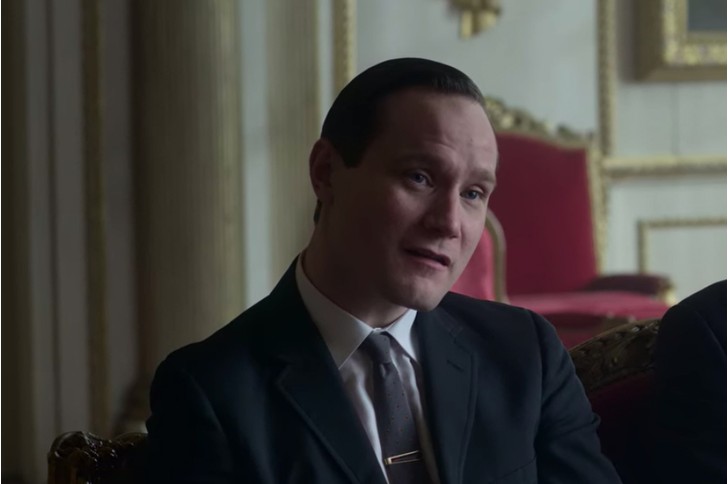
Earlier, the television announcer describes Michael Collins, the astronaut who stayed behind to orbit the moon while Aldrin and Armstrong touched down, as “the loneliest man in the universe” and the camera lingers on Philip’s face. On Philip’s “moon-landing,” or Philip’s meeting with the astronauts, he doesn’t find the answers he’s seeking. He’s left feeling empty and alone.
The meeting, while a disappointment, brings Philip back down to earth and spurs him in the right direction. After visiting his mother’s newly vacant room (we learn Philip has recently lost his mother, further adding to his existential struggles), he sits in the circle of clergymen once more and describes all the classic characteristics of a mid-life crisis. He tells them it was his mother who identified that he was missing his faith…he admits that he has lost it, and “without it, what is there?”
Faithlessness is going all the way to the moon to find vast emptiness and gloom.
Philip to the clergymen
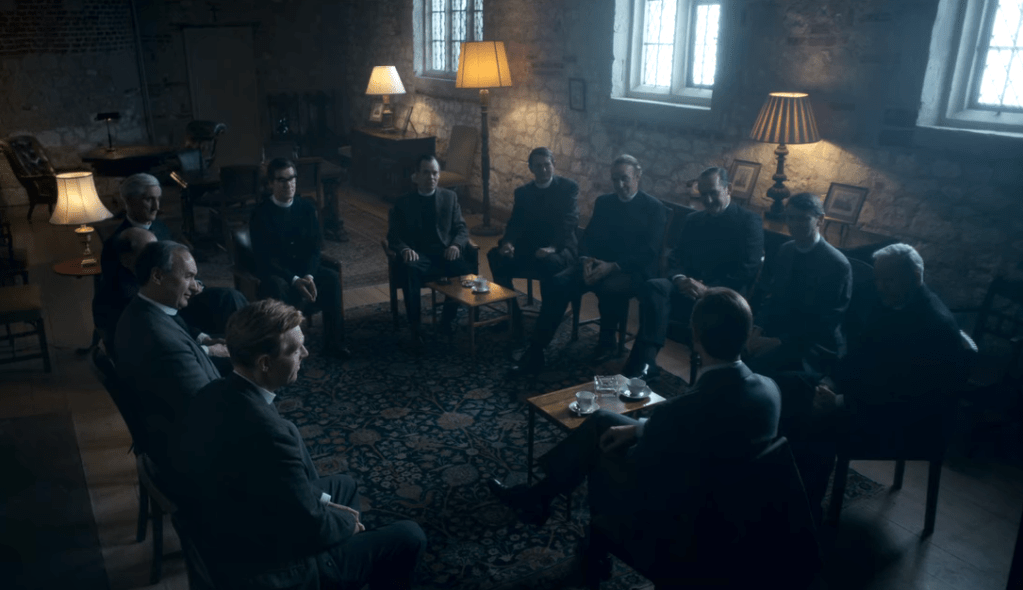
He continues that “the answer is in our faith…wherever it is that faith resides.” He now finds himself “full or respect and admiration” for what they are doing and sincerely asks them to help him. He laughs it off but it’s absolutely true that facing them and admitting his fears and weaknesses had to have been a thousand times harder for Philip than it would have been for him to go up in that rocket.
The revelation for Philip is not that he is in a state of crisis but rather, that he is not alone in those feelings. The wonder is not seeing him admit to those things, although that is a leap for his character, it is that he openly asks for their help.
The closing shots inform us that Philip and Robin Woods remained friends for a lifetime, and that St. Georges has continued its mission as a place for exploring faith and philosophy for over fifty years. While Philip’s speeches and ribbon cutting in his role as Duke of Edinburgh could not feel further from a moon landing, his unique position provided the opportunity to help establish something like St. Georges, and we’re told its success is an achievement of which he’s most proud.
Odds and Ends
Memorable Line:
When I consider thy heavens, the work of thy fingers, the moon and the stars, which thou hast ordained; What is man, that thou art mindful of him? and the son of man, that thou visitest him?
Robin Woods quoting Psalm 8:3-4
 MGC
MGC 